



The concept of a private internet has evolved dramatically over the past decade, transforming from a niche concern of security professionals into a fundamental requirement for millions of users worldwide. In 2026, the need for genuine online privacy has never been more critical, as surveillance capabilities expand and data breaches become increasingly sophisticated. Understanding what constitutes a truly private internet experience requires examining the technical infrastructure, encryption protocols, and privacy-enhancing technologies that work together to shield your digital activities from prying eyes.
Understanding the Foundation of a Private Internet
A private internet begins with fundamental technical components that secure your connection from the moment data leaves your device. At its core, building privacy requires multiple layers of protection working simultaneously to prevent exposure at different points in the data transmission chain.
The essential building blocks include:
- Encrypted connections that scramble all traffic between your device and destination servers
- Secure DNS resolution that prevents observers from seeing which websites you visit
- Server infrastructure positioned globally to provide both performance and anonymity
- Authentication protocols that verify connections without exposing user identity
- Privacy-focused logging policies that prevent data retention
The Role of VPN Infrastructure
Virtual Private Network technology serves as the cornerstone of most private internet implementations today. When properly configured, a VPN creates an encrypted tunnel that shields all internet traffic from local network administrators, internet service providers, and potential attackers monitoring network traffic.
Modern VPN services like ZioFree deploy sophisticated encryption standards including AES-256, which remains computationally infeasible to break even with advanced computing resources. The strength of encryption determines whether your private internet remains genuinely private or merely provides a false sense of security.
| VPN Component | Privacy Function | Technical Standard |
|---|---|---|
| Encryption Cipher | Scrambles data content | AES-256-GCM |
| Authentication | Verifies tunnel endpoints | RSA-4096 |
| Perfect Forward Secrecy | Limits key exposure | Ephemeral DH keys |
| Protocol | Establishes secure channel | OpenVPN, WireGuard |
The selection of VPN protocol significantly impacts both security and performance. OpenVPN has maintained its position as an industry standard due to extensive security auditing and proven reliability over decades of deployment.

DNS Privacy: The Often-Overlooked Component
Domain Name System queries represent one of the most significant privacy vulnerabilities in traditional internet architecture. Every time you visit a website, your device sends unencrypted DNS requests that reveal exactly which domains you're accessing, even when using HTTPS for the actual connection.
The IETF RFC 9076 (DNS Privacy Considerations) provides comprehensive analysis of DNS privacy threats and outlines mitigation strategies including DNS over TLS (DoT), DNS over HTTPS (DoH), and DNS over QUIC (DoQ).
Implementing Encrypted DNS
Encrypted DNS protocols prevent network observers from seeing your DNS queries, closing a major gap in creating a private internet experience. Understanding the differences between available protocols helps users make informed decisions about their privacy stack.
DNS encryption options available in 2026:
- DNS over HTTPS (DoH) - Encrypts queries within standard HTTPS connections
- DNS over TLS (DoT) - Uses dedicated TLS connections on port 853
- DNS over QUIC (DoQ) - Leverages QUIC protocol for reduced latency
- DNSCrypt - Authenticates and encrypts DNS traffic between client and resolver
The European Commission analysis of Encrypted DNS examines how these protocols impact both privacy and security from a policy perspective, highlighting the balance between user privacy and network security requirements.
Major operating system vendors have recognized the importance of encrypted DNS, with Microsoft documentation on DNS over HTTPS demonstrating how Windows Server and client systems now support these protocols natively.
Privacy-Enhancing Technologies Beyond Encryption
Creating a comprehensive private internet requires technologies that extend beyond simple encryption. Privacy-Enhancing Technologies (PETs) encompass a broader range of tools and techniques designed to minimize data exposure while maintaining functionality.
The NIST PETs Testbed initiative provides practical frameworks for evaluating and deploying these technologies in real-world environments. Organizations seeking to implement privacy-focused solutions can leverage these resources to assess effectiveness before deployment.
Advanced Privacy Techniques
Modern privacy-enhancing technologies employ sophisticated mathematical and cryptographic techniques to protect data even during processing and analysis. These approaches enable functionality while minimizing privacy risks.
Key PET categories include:
- Differential privacy - Adds controlled noise to datasets to prevent individual identification
- Homomorphic encryption - Enables computation on encrypted data without decryption
- Secure multi-party computation - Allows collaborative analysis without revealing individual inputs
- Zero-knowledge proofs - Proves knowledge of information without revealing the information itself
- Federated learning - Trains AI models across distributed devices without centralizing data
The NIST guidelines on differential privacy provide technical frameworks for evaluating privacy guarantees, particularly relevant as AI systems become increasingly integrated into internet services.

No-Logs Policies: Trust and Verification
A fundamental component of any private internet service involves data retention policies. No-logs policies commit providers to avoiding storage of user activity data, connection logs, and personally identifiable information that could compromise privacy if accessed by third parties.
Understanding what no-logs policies truly mean requires examining specific implementation details rather than accepting marketing claims at face value. Genuine no-logs commitments specify exactly what data is and isn't collected, retained, or shared.
| Data Category | Collected? | Retention Period | Privacy Impact |
|---|---|---|---|
| Connection timestamps | No | N/A | High |
| Bandwidth usage | Aggregate only | 24 hours | Low |
| Originating IP addresses | No | N/A | High |
| DNS queries | No | N/A | High |
| Visited websites | No | N/A | High |
Verification and Auditing
Claims about privacy policies require independent verification to maintain credibility. Third-party security audits, transparency reports, and public warrant canaries provide mechanisms for users to assess whether providers honor their commitments.
The ICO report on PET adoption barriers identifies organizational and technical challenges in implementing privacy technologies, highlighting the gap between policy commitments and actual implementation.
Threat Modeling for Private Internet Usage
Understanding specific threats facing your online activities enables appropriate selection of privacy tools and techniques. Different users face different risk profiles requiring customized approaches to achieving a private internet experience.
Common threat scenarios in 2026 include mass surveillance by internet service providers, targeted attacks by sophisticated adversaries, commercial tracking for advertising purposes, and data harvesting by websites and applications.
Assessing Your Privacy Needs
Begin by identifying what you need to protect and from whom. Corporate users protecting trade secrets face different threats than individuals concerned about advertising tracking or journalists protecting source communications.
Privacy threat categories:
- Local network surveillance - Network administrators, ISP monitoring, public WiFi attackers
- Government surveillance - Mass data collection, targeted investigation, border searches
- Commercial tracking - Advertising networks, data brokers, analytics platforms
- Malicious actors - Hackers, identity thieves, competitors, stalkers
Understanding whether your public WiFi connection is safe becomes particularly important for mobile users who frequently connect through untrusted networks.
The PoPETs research on mitigating inference risks demonstrates how formal threat modeling frameworks help identify and address privacy vulnerabilities systematically.
Comparing Privacy Solutions in 2026
Multiple approaches exist for achieving private internet access, each with distinct advantages, limitations, and appropriate use cases. Evaluating these solutions requires understanding both technical capabilities and practical usability factors.
VPN Services vs. Other Privacy Tools
Virtual private networks remain the most accessible and comprehensive solution for most users seeking a private internet experience. However, understanding how they compare to alternatives helps users make informed decisions.
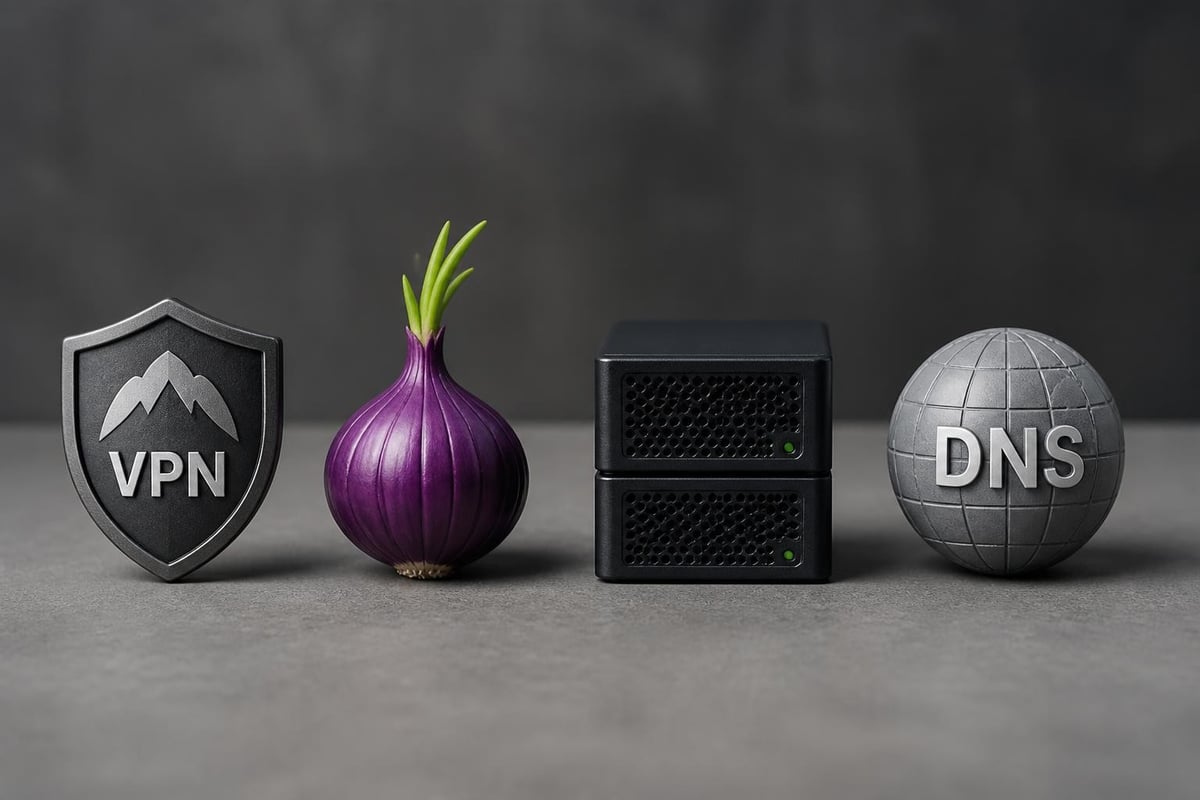
| Solution | Privacy Level | Speed Impact | Ease of Use | Cost |
|---|---|---|---|---|
| Premium VPN | High | Minimal (5-15%) | Very Easy | $3-12/month |
| Tor Network | Very High | Significant (60-80%) | Moderate | Free |
| Proxy Services | Low-Medium | Minimal | Easy | Free-$5/month |
| Private DNS Only | Low | None | Easy | Free |
Learning about what VPNs are and why you need one provides foundational knowledge for users new to privacy tools. The technology has matured significantly, making implementation straightforward even for non-technical users.
Understanding the difference between VPNs and incognito mode prevents common misconceptions about browser privacy features, which provide minimal protection compared to comprehensive VPN solutions.
Technical Infrastructure Requirements
Building a reliable private internet infrastructure requires careful attention to server deployment, network architecture, and redundancy planning. The technical foundation determines both privacy guarantees and practical usability.
Global Server Networks
Geographic distribution of VPN servers directly impacts both performance and privacy capabilities. Servers positioned closer to users reduce latency, while diverse jurisdictions provide protection against localized legal demands or network interference.
Key infrastructure considerations:
- Physical server locations across multiple continents and legal jurisdictions
- Owned vs. rented hardware and implications for data security
- Network capacity and bandwidth provisioning for peak usage
- Redundancy and failover mechanisms to maintain service availability
- Regular security updates and patch management across infrastructure
Recent ZioFree product updates introducing faster servers demonstrate how infrastructure improvements directly enhance user experience while maintaining privacy protections.
Artificial Intelligence and Private Internet Challenges
The rapid expansion of AI-powered services introduces new privacy challenges that traditional private internet approaches may not fully address. Machine learning systems often require substantial data access, creating tension between functionality and privacy.
The ArXiv review of privacy-enhancing technologies for AI examines how PETs can enable AI deployment while protecting individual privacy. Techniques like federated learning and differential privacy allow model training without exposing sensitive user data.
AI-Specific Privacy Considerations
Artificial intelligence systems can inadvertently leak private information through model outputs, training data memorization, or inference attacks. Protecting privacy in AI-enabled services requires specialized approaches beyond network-level encryption.
AI privacy protection methods:
- Training on encrypted data using secure multi-party computation
- Adding differential privacy guarantees to model outputs
- Federated learning to keep training data on user devices
- Synthetic data generation to replace sensitive real-world examples
- Privacy-preserving inference that protects both queries and model parameters
As AI integration deepens across internet services, maintaining a private internet experience requires addressing these algorithm-level privacy risks alongside traditional network security measures.
Evaluating VPN Provider Claims
The VPN market has expanded dramatically, with hundreds of providers making privacy claims that range from accurate to misleading. Evaluating these claims requires understanding specific technical and operational factors that determine actual privacy protection.
Questions to ask when assessing VPN providers include jurisdiction and legal environment, encryption standards and protocol implementations, logging policies and data retention practices, ownership structure and funding sources, and independent audit results and transparency reports.
Exploring pricing structures helps users understand the economic model supporting privacy services. Free VPN services often monetize through data collection or advertising, contradicting privacy objectives.
Red Flags and Warning Signs
Certain provider characteristics should raise immediate concerns about privacy commitments. Unrealistic claims, lack of transparency, or suspicious business practices often indicate inadequate privacy protection.
Warning signs to watch for:
- No clear information about company ownership or jurisdiction
- Claims of "100% anonymous" or "military-grade" security without specifics
- Absence of published privacy policy or terms of service
- Free services with unclear revenue models
- Refusal to disclose encryption protocols or technical implementation
- No independent audits or transparency reports
- Presence in known data-sharing jurisdictions without adequate safeguards
Understanding these warning signs helps users avoid services that provide false privacy assurances while potentially collecting and selling user data.
Practical Implementation Steps
Transitioning to a private internet approach requires systematic implementation rather than hoping individual tools automatically provide comprehensive protection. Following structured steps ensures complete coverage without gaps that could compromise privacy.
Setting Up Your Private Internet Stack
Begin with foundational protections and layer additional privacy measures based on your specific threat model and requirements. Each component addresses different aspects of the privacy challenge.
Implementation checklist:
- Select and configure a trusted VPN service with strong encryption
- Enable encrypted DNS through DoH, DoT, or provider-specific solutions
- Configure browser privacy settings and install privacy-focused extensions
- Review and restrict application permissions on mobile devices
- Enable two-factor authentication on critical accounts
- Regularly update all software to patch security vulnerabilities
- Use unique, strong passwords with a password manager
Considering private internet security comprehensively requires addressing multiple layers simultaneously rather than relying on any single tool.
Monitoring and Maintaining Privacy
Establishing a private internet configuration represents only the starting point. Ongoing monitoring and maintenance ensure continued protection as threats evolve and technology changes.
Regular privacy hygiene includes testing VPN connections for DNS leaks or IP exposure, reviewing privacy settings after software updates, monitoring for unusual account activity, updating encryption protocols as standards evolve, and reassessing threat models periodically.
Monthly privacy maintenance tasks:
- Verify VPN connection integrity using leak testing tools
- Review connected devices and revoke access for unused services
- Check for and install security updates across all devices
- Audit browser extensions and remove unnecessary items
- Review privacy settings on social media and online accounts
These routine practices help identify and address privacy gaps before they result in data exposure.
Future Developments in Private Internet Technology
Privacy technology continues evolving rapidly as researchers develop new approaches and existing tools mature. Understanding emerging trends helps users prepare for future privacy challenges and opportunities.
Post-quantum cryptography development aims to protect against future quantum computing attacks that could break current encryption standards. Decentralized identity solutions reduce reliance on centralized authentication providers. Zero-knowledge proof applications expand to enable privacy-preserving verification across more use cases.
Privacy-focused internet protocols under development include improvements to transport-layer security, enhanced metadata protection, and better integration of privacy features at the protocol level rather than as add-ons.
The landscape of private internet solutions will continue shifting as technology advances, regulatory environments change, and user awareness grows. Staying informed about developments ensures you can adapt your privacy approach to maintain protection against evolving threats.
Building a private internet experience in 2026 requires understanding multiple technical layers, from VPN encryption to DNS privacy and beyond. The right combination of tools and practices shields your online activities from surveillance, tracking, and unauthorized access. ZioFree provides the high-speed VPN infrastructure, strong encryption standards, and genuine no-logs commitment needed to achieve comprehensive online privacy, backed by global server coverage and advanced security protocols designed to protect against sophisticated threats.