




Finding a cheap VPN that delivers reliable security and privacy protection has become increasingly important as internet surveillance expands globally. With dozens of providers competing for your attention, price alone should never be the deciding factor. However, budget-conscious users can still find affordable options that maintain robust encryption, respect privacy rights, and deliver the performance needed for daily browsing, streaming, and remote work. This guide explores how to identify legitimate low-cost VPN services while avoiding providers that compromise your security to reduce prices.
Understanding What Makes a VPN Truly Affordable
Price comparisons can be misleading when evaluating VPN services. A cheap VPN advertised at $2 per month might seem attractive until you discover hidden renewal fees, bandwidth caps, or connection limits that reduce its practical value. True affordability combines reasonable pricing with features that justify the cost.
Beyond the Monthly Price Tag
The total cost of VPN ownership extends beyond subscription fees. Consider these factors when calculating real value:
- Server network size and geographic distribution
- Simultaneous device connections allowed
- Bandwidth limitations or throttling policies
- Customer support availability and quality
- Contract length requirements for advertised pricing
Most premium VPN providers offer significant discounts for longer commitments. A service priced at $12 monthly might drop to $3 monthly with a two-year plan, transforming it into a genuinely cheap VPN option. According to Consumer Reports' analysis of VPN services, pricing transparency and clear renewal terms separate reputable providers from those using deceptive marketing tactics.

Features That Matter at Every Price Point
Regardless of cost, certain capabilities remain non-negotiable for VPN effectiveness. Budget providers sometimes cut corners on essential security features to maintain low prices.
| Essential Feature | Why It Matters | Red Flag |
|---|---|---|
| Strong encryption (AES-256) | Protects data from interception | Proprietary or unspecified encryption |
| No-logs policy | Prevents activity tracking | Vague privacy policy language |
| Kill switch | Stops data leaks if VPN disconnects | Feature limited to premium tiers |
| Modern protocols | Ensures performance and security | Only outdated protocols supported |
A strict no-logs policy represents the foundation of VPN privacy, yet verification requires independent audits that increase operational costs. Some cheap VPN services claim privacy protection while collecting connection timestamps, bandwidth usage, or IP addresses that could identify users.
Security Trade-offs in Budget VPN Services
Every cheap VPN makes strategic decisions about where to allocate limited resources. Understanding these trade-offs helps you select providers that prioritize features matching your needs while identifying those that compromise security for profit margins.
Where Budget Providers Reduce Costs
Low-cost VPN operations achieve pricing advantages through several methods:
- Smaller server networks concentrated in popular regions
- Fewer customer support channels or delayed response times
- Limited protocol options focusing on one or two implementations
- Advertising partnerships or data collection for revenue
- Shared infrastructure with parent companies or resellers
The EFF's Surveillance Self-Defense guide explains how VPN limitations affect privacy outcomes. A cheap VPN with 50 servers across 10 countries might serve most users adequately, while travelers or those facing targeted censorship require broader geographic coverage.
Dangerous Cost-Cutting Measures
Some practices cross the line from reasonable economy to security compromise:
- Free VPN models funded by selling browsing data
- Outdated encryption protocols vulnerable to known attacks
- DNS leaks that expose browsing activity despite VPN connection
- Logging detailed connection metadata for advertising purposes
- Malware injection or ad insertion into user traffic
Research published on arXiv examining privacy risks demonstrates how economic pressures influence VPN provider behaviors, particularly when business models depend on monetizing user data rather than subscription revenue.
Evaluating Cheap VPN Providers for Privacy

Price-conscious shoppers need systematic evaluation frameworks to identify genuine value among cheap VPN options. Privacy protection depends on factors extending beyond technical specifications to include legal jurisdiction, corporate ownership, and transparency practices.
Jurisdiction and Legal Framework
Where a VPN provider operates determines which laws govern data retention, surveillance cooperation, and user rights. A cheap VPN based in a privacy-respecting jurisdiction offers better protection than expensive services in countries requiring data collection.
Favorable privacy jurisdictions include:
- Switzerland (strong privacy laws, no mandatory data retention)
- Iceland (constitutional privacy protections)
- Panama (no data retention requirements)
- Romania (EU privacy protections without Five Eyes membership)
CISA's guidance on securing remote access software emphasizes understanding legal obligations affecting VPN providers, particularly regarding government access requests and data preservation requirements.
Transparency reports indicating how providers respond to legal demands separate privacy-focused services from those quietly cooperating with surveillance requests. Services offering detailed information about their security practices demonstrate accountability worth considering regardless of price.
Ownership and Financial Incentives
The VPN industry has experienced significant consolidation, with several parent companies now controlling dozens of brand names. A cheap VPN might share infrastructure, logging policies, and management with premium-priced competitors under the same ownership.
Due diligence requires researching:
- Parent company identity and history
- Other brands under the same ownership
- Revenue models (subscriptions, ads, data sales)
- Investment sources and stakeholder interests
Technical Capabilities Worth the Investment
Even with limited budgets, certain technical features justify slightly higher costs among cheap VPN options. These capabilities directly impact security effectiveness and user experience.
Protocol Support and Performance
Modern VPN protocols balance security, speed, and compatibility differently. Budget providers often support fewer options:
| Protocol | Security | Speed | Compatibility | Best For |
|---|---|---|---|---|
| WireGuard | Excellent | Fastest | Improving | General use, mobile |
| OpenVPN | Excellent | Moderate | Widespread | Reliability, customization |
| IKEv2/IPsec | Very Good | Fast | Good | Mobile connections |
| L2TP/IPsec | Adequate | Moderate | Universal | Legacy device support |
The NIST Guide to IPsec VPNs provides technical standards background explaining why protocol selection matters for security. A cheap VPN supporting only outdated PPTP protocol cannot provide adequate protection regardless of other features.
Services focused on fast VPN performance typically invest in modern protocol implementations optimized for current internet infrastructure. This investment shows commitment to user experience alongside security.
DNS Leak Protection and Kill Switches
Two features prevent privacy failures when VPN connections falter. DNS leaks occur when domain name queries bypass the VPN tunnel, exposing browsing activity even while the connection appears secure. Kill switches automatically block internet traffic if VPN protection drops unexpectedly.
Budget constraints sometimes force cheap VPN providers to implement these protections only in desktop applications, leaving mobile users vulnerable. Comprehensive implementation across all supported platforms indicates quality engineering despite lower prices.
Red Flags That Indicate Problematic Services
Certain warning signs should immediately disqualify VPN providers regardless of attractive pricing. These indicators suggest business practices incompatible with genuine privacy protection.
Marketing Claims That Don't Add Up
Exaggerated advertising often signals deeper problems:
- "Military-grade encryption" without protocol specifics
- Impossible privacy promises ("completely anonymous," "untraceable")
- Free VPN claims without explaining revenue sources
- Unrealistic performance guarantees for cheap VPN pricing
The PrivacyTools recommendations emphasize verifiable claims over marketing language, providing community-curated criteria for evaluating VPN selection beyond price alone.
Lack of Transparency and Audits
Reputable VPN providers submit to independent security audits verifying their technical claims and privacy policies. The Tor Project's VPN audit coverage demonstrates how third-party verification builds trust through transparent evaluation.
A cheap VPN avoiding audit costs might seem reasonable initially, but this decision often conceals practices that wouldn't survive independent scrutiny. Look for providers publishing audit results even when findings identify areas for improvement.
Suspicious Installation Requirements
Legitimate VPN software requires appropriate system permissions for network management. Excessive permission requests or unusual installation behaviors suggest potential malware:
- Requests for unnecessary device access (contacts, photos, microphone)
- Installation of browser extensions without clear disclosure
- Bundled software not clearly described during setup
- Certificates requiring manual installation without explanation
Alternatives to Consider Alongside Cheap VPN Options
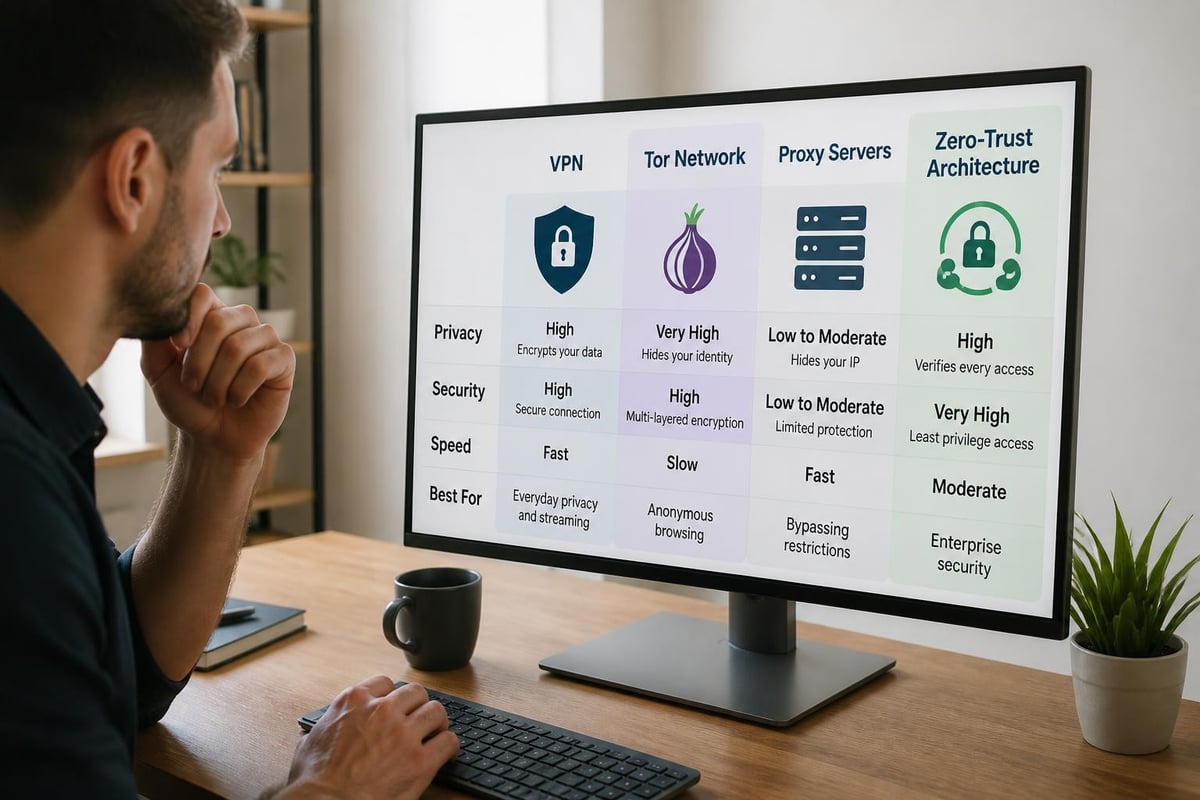
VPNs represent one tool among several for protecting online privacy and security. Understanding alternatives helps determine whether a cheap VPN meets your actual needs or whether different solutions offer better value.
The Tor Network for Anonymity
While VPNs provide privacy through encrypted tunnels, Tor offers stronger anonymity through routing traffic across multiple volunteer-operated nodes. The Tor Project's explanation of VPN and Tor differences clarifies when each tool provides appropriate protection.
Tor advantages:
- Free and open-source
- Designed specifically for anonymity
- No centralized provider to trust
Tor limitations:
- Significantly slower than VPN connections
- Some websites block Tor exit nodes
- Not suitable for bandwidth-intensive activities
Combining VPN and Tor requires understanding how layering affects traffic routing and whether increased complexity creates new vulnerabilities.
Modern Zero-Trust Architectures
CISA's guidance on modern network access security encourages alternatives to traditional VPNs for organizational security, particularly approaches verifying every connection regardless of network location.
For personal use, these principles suggest combining multiple protective measures rather than relying exclusively on VPN connections. Browser privacy extensions, HTTPS-only modes, and DNS-over-HTTPS complement VPN protection without requiring additional subscriptions.
Finding the Right Balance Between Cost and Security
Selecting a cheap VPN requires balancing legitimate budget concerns with security requirements specific to your threat model and usage patterns. Different users face different risks requiring customized protection strategies.
Assessing Your Personal Threat Model
Not everyone needs maximum security features. Honest threat assessment prevents both overpaying for unnecessary protection and choosing inadequate cheap VPN options:
Basic privacy from ISP tracking:
- Simple no-logs VPN sufficient
- Modern protocol support important
- Large server network less critical
Protection on public WiFi networks:
- Strong encryption essential
- Kill switch prevents accidental exposure
- Mobile app quality matters more than server count
Circumventing geographic restrictions:
- Server locations in target regions required
- Performance and reliability prioritized
- Information about privacy features helps evaluate options
Protection from targeted surveillance:
- Jurisdiction outside monitoring alliances critical
- Independently audited no-logs policy required
- Additional anonymity tools may be necessary
Calculating Long-Term Value
The cheapest initial price rarely delivers the best long-term value. Consider these factors when comparing options:
- Renewal pricing after promotional periods end
- Plan flexibility if needs change before contract expires
- Money-back guarantee allowing risk-free testing
- Device limits affecting family or multi-device use
- Feature access across pricing tiers
A cheap VPN offering transparent pricing structures demonstrates confidence in delivering value beyond introductory discounts. Services hiding renewal costs in fine print often disappoint users after initial commitment periods.
Questions to Ask Before Committing
Before purchasing any cheap VPN subscription, demand clear answers to critical questions:
- What user data does the provider log, if any?
- Which third parties can access user information?
- How does the service generate revenue at this price point?
- What happens to data if the company faces legal demands?
- Which independent audits verify security and privacy claims?
Providers offering detailed FAQ responses and transparent information about their operations deserve consideration over services hiding behind vague marketing language. Your privacy depends on trusting strangers with sensitive data, making thorough evaluation essential regardless of attractive pricing.
Making Your Decision
Selecting a cheap VPN ultimately requires trusting that the provider will honor privacy commitments despite limited oversight. This trust should rest on verifiable evidence rather than marketing promises. Look for services demonstrating operational transparency, submitting to independent audits, and maintaining clear communication about capabilities and limitations.
The VPN landscape continues evolving with new providers entering the market and established services adjusting their offerings. Staying informed about current VPN industry developments helps identify emerging options and avoid providers cutting corners as competition intensifies.
Remember that price represents just one factor among many determining VPN value. A cheap VPN delivering reliable privacy protection at $3 monthly provides far better value than an expensive service selling users' browsing data despite premium pricing. Focus on verifiable security features, honest privacy policies, and transparent business practices to identify affordable options worthy of your trust.
Choosing a cheap VPN requires careful evaluation beyond headline pricing to ensure you receive genuine privacy protection without hidden compromises. By focusing on verifiable security features, transparent policies, and honest business practices, budget-conscious users can find affordable services delivering reliable protection. ZioFree combines competitive pricing with strong encryption, a global server network, and a verified no-logs policy while protecting you from surveillance attempts, offering the security you need at a price that respects your budget.